Roleta dzień noc na drzwi balkonowe – wymiar, prowadzenie i montaż bez wiercenia
Balcony door blinds that actually work are rarer than they look in online galleries. The glass surface is the largest in the apartment, the handle sticks out, and the slightest gust from an tilted window puffs the fabric like a sail. A roller blind for a balcony door must therefore be treated individually: a properly selected material, adequate dimensions and a mechanism that keeps the fabric taut are not a luxury but a technical necessity.
- Jak zmierzyć drzwi balkonowe do rolety dzień noc bez błędu przy klamce
- Roleta dzień noc z prowadzeniem żyłkowym na balkon: stabilność przy uchylaniu
- Montaż rolety dzień noc na drzwi balkonowe bez wiercenia
- Tkaniny do rolety dzień noc na balkon: jak dobrać strukturę i kolor
- Jak dbać o roletę dzień noc na drzwiach balkonowych przez lata
- Najczęściej zadawane pytania przy wyborze rolety na balkon
Jak zmierzyć drzwi balkonowe do rolety dzień noc bez błędu przy klamce
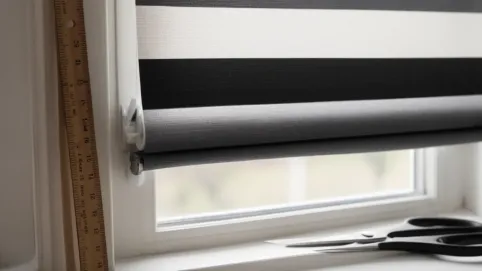
The most common reason a day-night blind fails in everyday use is a measurement error by a few millimetres that pushes the fabric over the handle, blocking its operation. Before ordering, measure the width of the glazed part in three places: at the top, in the middle and at the bottom, then write down the largest value. Do the same with the height, adding about 5 cm to the result, because the cassette or top tube always takes up some space.
Next, determine the distance between the planned edge of the blind and the handle axis. A safe gap is a minimum of 4 cm on the side where the handle sits, and 3 cm on the opposite side. This is not arbitrary: the weave of a day-night fabric, when layered with alternating transparent and dimming stripes, expands slightly during the day due to thermal expansion, so a fabric tightened to the handle after six months starts to press against it and wears through the inner layer.
Check whether the frame is flush with the wall or whether the sill protrudes outward. In older buildings from the 1990s, the frames often protrude by 2 to 3 cm, which prevents a cassette blind from being mounted on a standard bracket. In such situations either an undercut bracket is used or mounting is shifted onto the upper horizontal part of the frame.
Make a note of the tilt clearance. The frame of a tilt-and-turn balcony door usually allows the sash to open outward at an angle of about 90 degrees and inward by a tilt of about 15 cm. The blind with side guides must not interfere with this tilt, which is why the guides cannot be longer than 5 cm below the upper frame edge, this way the fabric can slide freely even with the sash tilted.
Write the measurements down on paper, not in the mobile, because a pen and paper force you to think about the sequence. The measurements are later compared with the manufacturer's configurator, which automatically calculates whether a given height is achievable with a single panel or whether a joint will be necessary. For heights above 220 cm most manufacturers use a tube diameter of 38 mm instead of the standard 28 mm, because the longer fabric simply sags on a thinner tube.
Najczęstszy błąd: ordering a blind "flush" with the handle without leaving a side clearance, the fabric then stops on the first warm day and scratches the powder-coated handle.
Roleta dzień noc z prowadzeniem żyłkowym na balkon: stabilność przy uchylaniu
The cable guide mechanism looks inconspicuous, but its physics solve the main problem of every tall blind: lateral drift of the fabric. Two steel cables with a diameter of 1.2 to 1.5 mm run vertically from the upper bracket to the lower tensioner in the window sill. The tensioner is a small spring that keeps the cables under constant tension, which translates into a slight horizontal force holding the fabric in one plane.
Without this guide a fabric hung loosely on a 230 cm window behaves like a pendulum. A tilt of the sash generates a difference in pressure between the room and the outside, and the fabric starts to bulge inward. Repeated cycles of bulging and straightening quickly damage the lower hem, the stitching frays and the fabric no longer falls evenly. The cable guide eliminates this phenomenon at the source, because the fabric physically cannot move more than 1 mm sideways.
There are two types of tensioners. The first, a hook with a spring visible on the surface, makes it easier to detach the cables when washing the window. The second, a flush-mounted disc set into the sill, looks better but requires drilling a 12 mm hole. In a rented apartment the disc version will likely not pass the inspection of the building manager, so the hook version remains the practical choice.
The material of the cables also matters. A cable made of twisted stainless steel can carry a load of about 40 kg and does not stretch over time. Cables coated with a transparent PVC sheath look discreet but after two seasons the sheath becomes cloudy and starts to yellow. Where the balcony faces south and the windows heat up to 50 degrees Celsius in summer, an uncoated steel cable is a more durable choice despite its less aesthetic appearance.
The guide spacing on the fabric is another technical parameter. The optimal distance between the cables is 18 to 22 cm. With a narrower spacing the fabric loses its natural drape and looks like a stretched banner. With a wider spacing, greater than 25 cm, the cables stop providing adequate support in the central part and the effect of a taut blind is lost. Most configurators allow these spacings to be set in 2 cm increments.
Parametry techniczne prowadzenia żyłkowego
| Parametr | Wartość | Znaczenie praktyczne |
|---|---|---|
| Średnica linki | 1.2-1.5 mm | Udźwig 35-40 kg |
| Napięcie wstępne | 15-20 N | Eliminuje efekt żagla |
| Rozstaw prowadzenia | 18-22 cm | Optymalny kompromis |
| Długość prowadzenia | do 240 cm | Maksymalny zasięg produkcyjny |
Montaż rolety dzień noc na drzwi balkonowe bez wiercenia
An invasive-free mounting works on tension, not on screws, which is its greatest advantage and limitation at the same time. The upper bracket is pressed against the frame with a spring-loaded mechanism; the lower tensioner hooks into the sill profile. No hole, no plug, no screw. The installation takes about 7 minutes per door and just as easily the whole kit can be removed before painting or moving out.
The downside is the limited load-bearing capacity of the tension mechanism. The pressing force of the bracket is in the range of 30 to 50 kilograms at the top and 15 to 25 kilograms at the bottom. A fabric heavier than 180 g/m² plus a 38 mm tube can exceed these limits, especially on tall windows. In such a situation the bracket starts to slide down after a few months and leaves marks on the frame.
Another key point is the type of frame. PVC frames with a chamber structure, which are the most common in new construction, hold a tension bracket very well because the chamber provides space for the clamping jaws. Wooden frames also work well, provided that the wood is not cracked. Aluminium frames, especially those with a thermal break, are a problem because their thin walls deform under pressure and the bracket loosens after two weeks. Here only screwing or special adhesive brackets remain.
| Metoda | Montaż | Maksymalne obciążenie | Kiedy stosować |
|---|---|---|---|
| Bezinwazyjny (na napinacze) | 5-10 min | do 1.8 kg/mb | Wynajem, krótkie rolety, tkaniny lekkie |
| Kasetowy z przykręcaniem | 25-35 min | do 3.5 kg/mb | Drzwi aluminiowe, tkaniny ciężkie |
| Hybrydowy (zacisk + klej) | 15-20 min | do 2.5 kg/mb | Gładkie profile, brak możliwości wiercenia |
Lista narzędzi i checklist przed montażem
- Miarka zwijana z blokadą (dokładność 1 mm)
- Ołówek miękki do oznaczenia punktów montażu
- Poziomica 60 cm do kontroli pionu linek
- Wkrętak krzyżakowy (jedynie przy montażu kasetowym)
- Wiertarka 6 mm (jedynie przy montażu kasetowym)
- Ściereczka z mikrofibry do odtłuszczenia profili
Checklist przed zakupem: potwierdź wymiary w trzech miejscach, sprawdź odstęp od klamki minimum 4 cm, zmierz głębokość ramy, zweryfikuj nośność napinaczy, wybierz gramaturę tkaniny powyżej 130 g/m² dla okien powyżej 200 cm wysokości.
Tkaniny do rolety dzień noc na balkon: jak dobrać strukturę i kolor
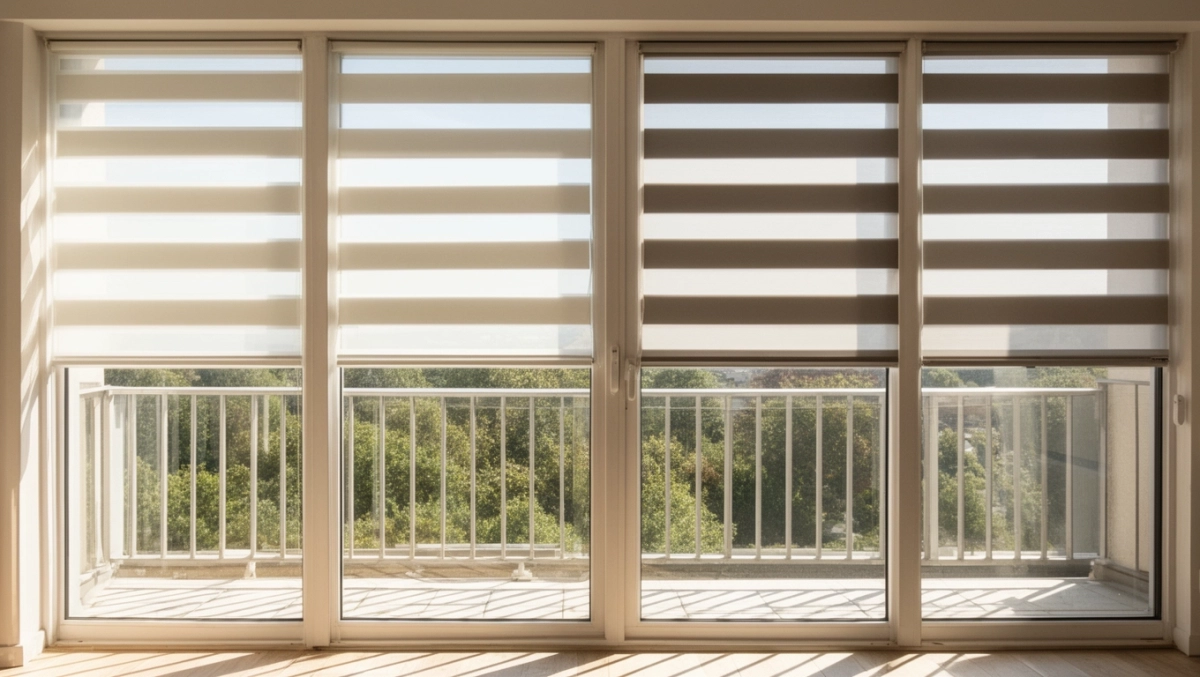
The day-night fabric is not a single layer but a set of horizontal stripes alternating between dimming and translucent panels. The dimming stripes are usually made of polyester with a weight of 140 to 220 g/m², while the translucent stripes are made of a thinner weave weighing 80 to 120 g/m². The ratio of dimming to translucent is usually 60:40 or 50:50, and this proportion determines how much light enters when the stripes overlap.
Classic fabrics with a uniform matte surface work in interiors where simplicity is the priority. Their advantage is resistance to fading: under UV exposure of class 4 to 5 (according to PN-EN ISO 105-B02) the colour stays unchanged for 5 to 7 years. The disadvantage is that they collect dust more visibly, so they need to be vacuumed once a month with a soft brush.
Melange fabrics, woven from two or three yarn colours, hide dirt better and give the interior depth. Their weight is usually around 170 g/m², which puts them in the middle range, they work well with cable guide and reach dimensions of up to 230 cm without sagging. In Scandinavian interiors, where the dominant colours are white, grey and beige, a melange in ash or graphite works beautifully.
Metallic fabrics with a reflective coating are an interesting option for south-facing balconies. The outer side reflects part of the solar radiation, which reduces the temperature inside by 2 to 3 degrees Celsius. The inner side has a matte finish, so the interior does not look like an office. The disadvantage is the higher price, usually 30 to 40% more than a classic fabric, and the need for careful cleaning without the use of alcohol-based agents.
Porównanie typów tkanin
| Typ tkaniny | Gramatura | Odporność UV | Efekt świetlny | Cena orientacyjna PLN/m² |
|---|---|---|---|---|
| Klasyczna | 140-180 g/m² | 5-7 lat | 50% transmisji | 120-160 |
| Melanż | 160-200 g/m² | 5-6 lat | 45% transmisji | 150-190 |
| Metaliczna | 180-220 g/m² | 8-10 lat | 30% transmisji | 220-280 |
When choosing a colour, look at the wall behind the balcony door in the late afternoon. The colours that look great in shop lighting under cool fluorescent lamps can take on a completely different tone under the warm rays of the setting sun. The safest rule is a colour two shades darker than the wall, then the blind frames the interior without dominating it.
Jak dbać o roletę dzień noc na drzwiach balkonowych przez lata
A day-night fabric with cable guide gets dusty faster than a classic curtain because the cables generate a slight electrostatic charge. Wipe it weekly with a dry microfibre cloth, moving from top to bottom so as not to lift the stripes from the rail. Once every three months, run a vacuum cleaner with a soft brush attachment along the entire length of the fabric, this removes particles that have settled deep between the layers.
Never soak the fabric or wash it in a washing machine. The cable guide steel cable in contact with detergent loses its anti-corrosion coating and starts to rust after about a year. If a stain appears, dab it gently with a sponge dampened with a 1:1 mixture of lukewarm water and a neutral pH detergent, then leave the blind half-open so the fabric can dry naturally.
The mechanism also requires periodic inspection. Every six months, check the tension of the cables by gently pressing them sideways, the deflection should not exceed 5 mm. If it does, the tensioner spring has weakened and needs to be replaced. The cost of a new spring is minimal and can be installed without dismantling the entire blind, just detach the lower hook from the sill.
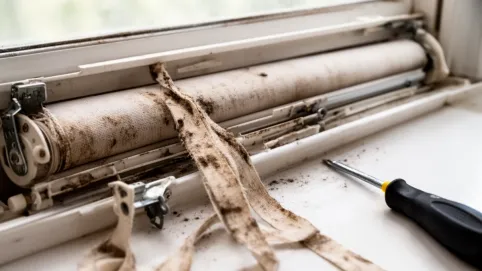
The chain drive is the next element to watch. The plastic ball chain used in many models is rated for about 5,000 cycles. With daily use of the blind that is about three years, after which the chain links start to crack. Replacing the chain costs little and can be done with a screwdriver in about 10 minutes. Lubricating the chain with silicone spray once a year extends its life by another 12 to 18 months.
The warranty for the mechanism in quality day-night blinds is usually 24 months, but with the above care the mechanism realistically lasts 7 to 10 years. The fabric itself, depending on exposure to UV radiation and cleaning regularity, retains its properties for 6 to 12 years, after which it can be replaced without having to buy a new mechanism.
Najczęściej zadawane pytania przy wyborze rolety na balkon
Can a day-night blind be installed on a door that opens outward? Yes, but only with a cable guide because the fabric cannot swing outward with the door. The lower hook then attaches to the frame, not the sill, which requires an additional mounting bracket.
Will a dark fabric cause the room to overheat? No, the opposite. A dark fabric absorbs more solar radiation on the outer side, while the inner side still reflects part of the visible spectrum. In practice, a dark dimming stripe reduces the temperature behind the glass by 3 to 5 degrees Celsius compared with no blind at all.
Is a non-invasive mount possible on an aluminium frame? Rarely. Aluminium frames have thin walls and the tension mechanism does not hold. In this case, screwing through an aluminum bracket or a special adhesive-backed clamp remains. The blinds themselves remain "free of drilling into the wall," but the frame still requires holes.
What height requires two-panel construction? Most manufacturers offer one panel up to 230 cm. Above this height the fabric becomes too heavy and the tube starts to sag in the middle. For windows up to 250 cm a vertical joint can be used, but aesthetically a single panel always looks better.
Are day-night blinds safe for allergy sufferers? Yes, the polyester fabric does not collect allergens and can be vacuumed. The important thing is regular dusting because the static charge of the cables attracts fine dust particles, which can be a problem for people allergic to house dust.
Windows above 210 cm require a set of specific parameters: a 38 mm tube, a 160 g/m² fabric, side cable guides with steel cables of 1.5 mm and a non-invasive mounting only when the frame is PVC or wooden. Aluminium frames require screwing. The handle needs at least 4 cm clearance on the side where it sits. The sash tilt clearance forces the guide cables to be mounted no lower than 5 cm below the upper frame edge.
The configuration that meets all the above conditions at the same time is the safest choice, not the cheapest, but the one that will actually work on the second and third season without the need for adjustment. A configurator that allows you to enter the exact dimensions, the position of the handle and the type of frame shortens the choice process from hours to minutes.
The measurement is best done in the morning, when the sash has not yet been opened a dozen times. Then a few minutes of measuring with a tape measure, a note of the measurements on paper and a completed configurator form are all that separates a successful purchase from a blind that blocks the handle after the first week.
Źródła danych i norm: PN-EN 13120 (wewnętrzne osłony okienne), PN-EN ISO 105-B02 (odporność barwy na światło), PN-EN 13501-1 (klasyfikacja ogniowa tkanin), PN-EN 13773 (właściwości tkanin w zakresie bezpieczeństwa). Dane techniczne dotyczące prowadzenia żyłkowego i napinaczy zgodne z kartami katalogowymi wiodących europejskich producentów osłon okiennych (rok referencyjny 2024).